
What Consistency Actually Means for Webcam Models (And How to Achieve It)


“Be consistent.”
This advice is everywhere in the webcam modelling world. In guides, in forums, and in Reddit posts. Everyone repeats it.
The problem is that most webcam models completely misunderstand what consistency actually is.
So in this article, I’m going to properly define:
what consistency really means
what it DOESN'T mean
how to measure it
how to emotionally regulate yourself using data
and how to actually achieve long-term consistent earnings
This is one of the biggest advantages you can give yourself as a webcam model, simply because almost nobody understands consistency at a systems level.
🎥 Video Version: What Consistency ACTUALLY Means for Webcam Models
What “Consistency” Actually Means for Webcam Models
The dictionary definition of consistent is:
“Acting or done in the same way over time, especially so as to be fair or accurate.”
The key phrase is over time.
This is exactly where most models go wrong. They interpret consistency as something that should show up immediately, day-to-day. They massively underestimate the time variable.
And because of that misunderstanding they:
panic on bad days
get overconfident on good days
change strategies early
misread normal variance as “something is wrong”
quit too early
never allow their system to play out long enough
Consistency exists on two layers. If you don’t separate them, everything becomes confusing.
The Two Layers of Consistency
There are inputs (behaviour) and outputs (results).
They are connected but they are not the same thing.
1. Consistency of Behaviour (Inputs)
This is the easy part and the part you fully control.
Consistency of behaviour simply means sticking to your system every day:
showing up at the same times
sticking to your schedule
streaming the intended number of hours
executing your behaviours the same way
running your process daily
This is the “you” part of the system, the part that sits inside your control.
If you don’t have consistent inputs, you have little chance of anything downstream being consistent.
2. Consistency of Outcomes (Outputs)
This is where models get confused.
They think: “If I’m consistent daily, my results should be consistent daily.”
But that’s not how the cam ecosystem works. Daily earnings are chaotic, noisy and full of variance, even when you execute everything perfectly.
And unless you understand how outputs behave over the right TIMEFRAME, your emotions will convince you that something is wrong, even when everything is fine.
Why Outcomes Are Not Consistent Day-to-Day
This is where the misunderstanding happens.
Daily results fluctuate because the cam ecosystem has dozens of variables outside your control:
viewer traffic
site algorithms
competing models
user behaviour
time of month, year, holidays
randomness
Even with consistent inputs, outputs will swing wildly.
That doesn’t mean your system is wrong. That doesn’t mean you’re doing anything wrong.
It simply means you’re operating inside a high-variance environment.
This brings us to one of the most important concepts.
Ideal Progress vs. Reality: What Webcam Earnings Really Look Like

In an ideal world, your earnings would follow a perfect 45-degree line from bottom-left to top-right. Linear progress. No variance. Every day slightly better than the last.
As humans we expect this as we think linearly, but actual daily earnings never look like this.
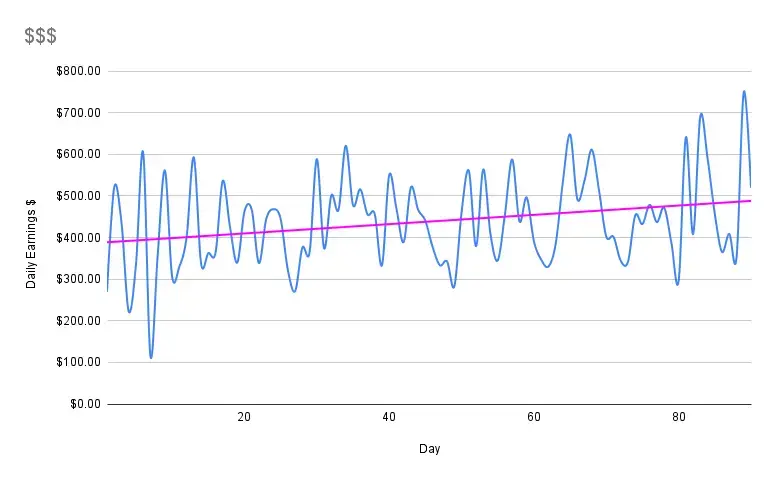
In reality, the graph looks drastically different:
big up days
bad days
big drops
random spikes
But when you zoom out and look at the trend line, the progress is real.
This is where regression to the mean comes in.
Regression to the Mean (Explained Simply)
Regression to the mean means that over a long enough time period, the highs cancel out the lows and the true average becomes clear.
Your daily randomness literally “cancels itself out” over weeks and months.
That’s why you cannot judge success based on:
today
yesterday
one good spike
one bad streak
You must measure your consistency on weekly and monthly averages, not individual days.
Consistent inputs create consistent long-term averages, not consistent daily outcomes. And this distinction changes everything.
Volatility Explained: Understanding Daily Swings in Webcam Income
Daily fluctuations above and below your average are simply called volatility.
Some models have low-volatility earnings. Others have huge swings, both up and down.
Volatility isn’t good or bad by itself. But understanding it removes emotional confusion.
If you know that your average daily swing is for example:
±$85 (absolute volatility)
±20% (relative volatility)
…then a “bad day” doesn’t feel like the end of your career, because you understand that it is normal and expected.
Having high-volatility is not necessarily a problem by itself, but you will need more emotional resillience to be able to deal with the bigger fluctuations of day-to-day earnings.
How to Calculate Simple Volatility
To calculate volatility in a simple, practical and beginner friendly way we can follow the below steps:
Take the last 30 days of earnings
Calculate your average daily earnings
For each day, subtract the average and take the absolute value (ignore + or –).
Take the average of all those deviations
You then have your absolute volatility number in $ amount. You can convert this to your relative volatility by calculating the percentage of your absolute volatility of your average earning over the past 30 days.
Here's an example using a 30-day data period, calculating both the absolute and relative volatility.

Once you quantify volatility, you:
stop panicking
stop overreacting
stop changing your system unnecessarily
can see whether volatility is trending up or down
can work to stabilise your performance
This is how you regulate yourself with data rather than emotion.
Why Consistency Does NOT Automatically Mean “Good”
This is an important nuance.
Consistency = “behaving the same way over time.”
It does NOT mean:
you’re improving
you’re growing
the trend is up
You can be:
consistently flat
consistently declining
consistently chaotic
Consistency is just one half of the equation of success.
To become a high performer, you need:
consistent inputs, and
a trend line that moves upward over time, not day-to-day
The two work together.
Drawdowns: What They Are and Why Models Panic During Them

A "drawdown" is simply a period where your daily earnings dip below your average.
Models often panic during drawdowns and assume:
“The site changed the algorithm.”
“The economy is crashing.”
“I’m no longer attractive.”
“Something is wrong with my system.”
But when you zoom out, drawdowns are just part of the cycle.
They’re not a sign you’re necessarily doing something wrong. They are expected and normal.
Once you understand volatility, variance and regression to the mean, your emotional reaction disappears.
Why Consistency Is the Ultimate Advantage in Webcam Modeling
Consistency works because the cam environment is high variance.
Showing up consistently simply maximises your exposure to the upside.
You never know which day will be:
a day where a high spending customer shows up
an unusually active chat
a session that triples your average
If you miss days because you’re emotional, you may miss days that maximise your upside.
Professional traders and casinos operate the same way:
they follow their system
they don’t emotionally react to randomness
they let probabilities play out
they review long-term averages, not single outcomes
You’re doing the same thing as a model.
When you show up and let the variance play out, your system finally has the time needed for your true performance trend to appear, and for you to improve it.
Final Thoughts
Once you truly understand consistency, volatility, variance and regression to the mean, webcam modelling becomes much clearer:
You stop panicking
You stop overreacting
You stop breaking your system prematurely
You stop tying your self-worth to your daily results
And instead, you start:
regulating yourself with data
planning long-term
executing a system
improving the trend, not the day
This is exactly how high-performing models operate.
If you want help building the actual systems, structures, and processes behind consistent, long-term results, you can check out the Xcite Accelerator linked below.


Comments